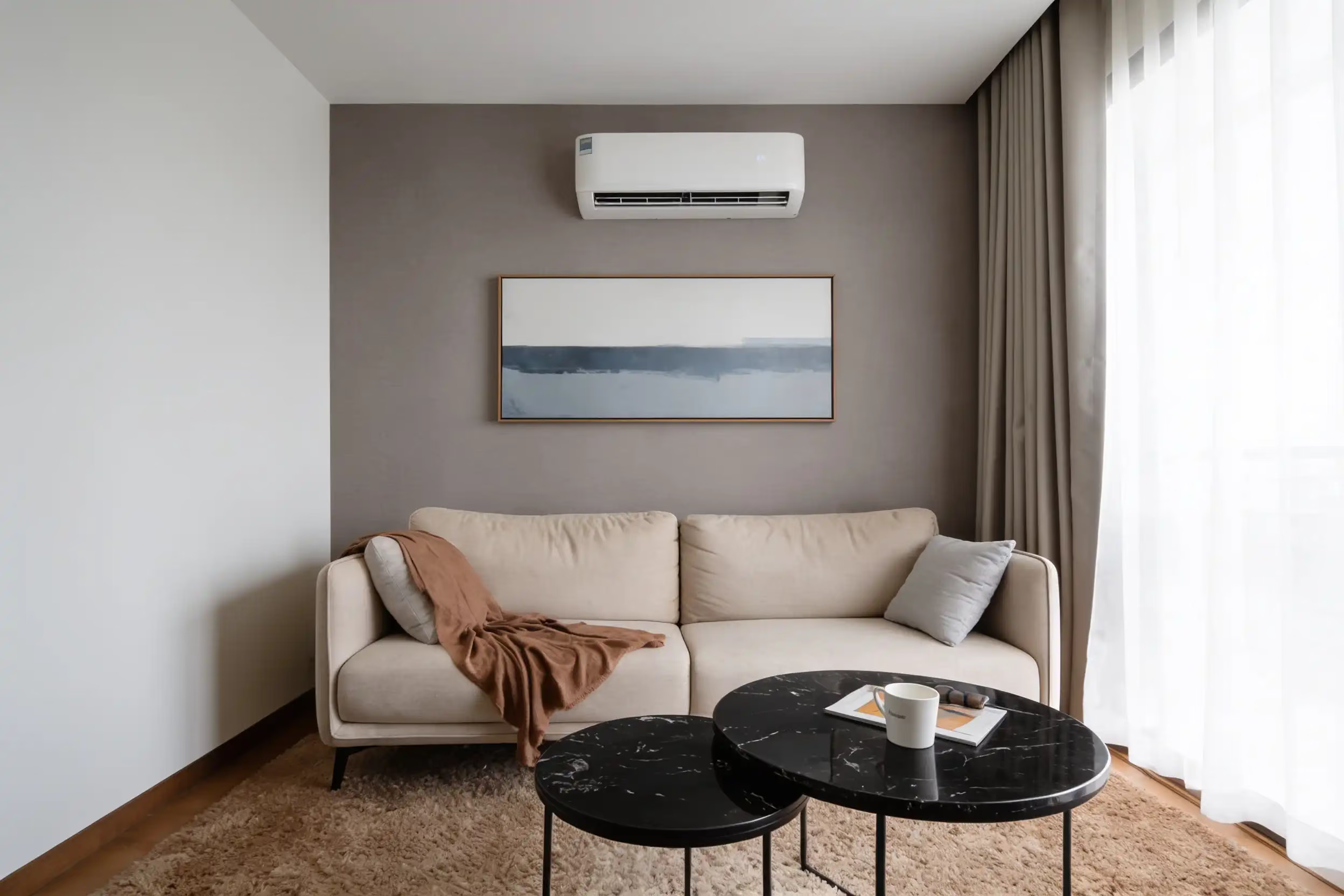
Split system installation, sized to the room
A split system is two units joined by a pair of copper pipes: the indoor head on the wall, and the outdoor unit with the compressor that does the hard work. Getting split system installation right comes down to two choices made before anyone drills a hole: the size of the unit, and where each half goes. Get those right and a split system runs quietly for years. Get them wrong and it either struggles all afternoon or switches on and off every few minutes.
We install split systems across Newcastle, Lake Macquarie and the Hunter, in everything from Mayfield weatherboards to two-storey homes in the newer estates out past Maitland.
What size air conditioner do I need?
Capacity is measured in kilowatts of cooling or heating output. These are the rough bands CHOICE publishes, and they line up with what we see on most Newcastle jobs:
| Room size |
Typical capacity |
| Up to 20 square metres (a bedroom or study) |
2 to 2.5kW |
| 20 to 40 square metres (a lounge) |
2.5 to 5kW |
| 40 to 60 square metres (a living and dining room) |
4 to 6kW |
| 60 to 80 square metres (open-plan living) |
5 to 7kW |
| Over 80 square metres |
6 to 9kW |
Those bands are a starting point. A room with big west-facing windows, a ceiling over 2.4 metres or no insulation in the roof needs more. A shaded bedroom used only at night can need less. An oversized unit isn't a safe bet either: it reaches the set temperature too quickly, switches off, and starts again, which wastes power and leaves the room clammy on a humid February night. We measure the room and look at the windows on the quote visit, then recommend one size, with the reason written on the quote.
Inverter air conditioners
An inverter air conditioner changes the speed of its compressor. Instead of running flat out and switching off, it slows down once the room is close to temperature and keeps it ticking over. That's quieter and uses less power over a long evening. When you compare models, the Zoned Energy Rating Label shows separate star ratings for cooling and heating, so check the heating stars too if you plan to use it through winter.
Where the outdoor unit goes
The outdoor unit is the noisy half, so its spot matters more than most people expect. It needs room to breathe on all sides, a level concrete pad or a solid wall bracket, and a place where the fan won't drone under a bedroom window. On a narrow terrace block in Cooks Hill or Islington, the side passage is often the only option, and we check how close the neighbour's window is before we settle on it.
Within a few kilometres of the beach, salt air eats at the outdoor coil and its fins. If you live near the coast, ask about models with a coastal coating on the coil, and plan on rinsing the outdoor unit with fresh water now and then, with the power off at the isolator first. Our air conditioning service includes a proper clean of the outdoor coil.
Back-to-back or a longer pipe run
The simplest job is back-to-back: the indoor head on an outside wall, the outdoor unit directly behind it, and a short pipe run through one hole. That's what our standard install price is built on. When the head has to go on an inside wall, or upstairs, the pipes run further, through the roof space or down the outside of the house in a cover. That takes more copper, more time and sometimes a pump to get the condensate water away, so it costs more. We show you the route before we quote, and every metre over our standard run is listed on its own line.
What a standard install includes
- The indoor head mounted level on a bracket, with the wall checked for pipes and wires first
- The outdoor unit on a pad or bracket, with clearance for airflow and servicing
- Insulated copper pipes, the drain line and the cable, run neatly and covered where they show outside
- Pipes pressure-tested and vacuumed before the refrigerant is released, so moisture and air don't end up in the system
- The unit connected and its associated wiring done under our air conditioning and refrigeration licence
- A test run in cooling and heating, the remote set up, and a walk-through of the filters
- Rubbish taken away, and the warranty registered with the manufacturer
Multi head split systems
A multi head split system runs two or more indoor heads off one outdoor unit. It suits a house where three bedrooms each need cooling but there's only room outside for one unit, or where a body corporate limits what can go on the wall. The trade-off is that all the heads depend on that one outdoor unit, so if it stops, every room goes warm at once. Published 2026 cost guides put multi-head systems at about $4,200 to $8,000 installed, adding roughly $1,000 to $1,500 for each extra head. If you're cooling most of the house, it's worth comparing against ducted: our post on split system vs ducted sets the two side by side, and our ducted air conditioning page covers the other path.
Split system installation cost
So, how much does it cost to install a split system? Published Australian cost guides in 2026 put a single split at roughly $1,800 to $4,800 supplied and installed. Those are typical national figures, not ours. The spread comes from the unit's size and brand, the length of the pipe run, the height of the wall, and whether the house needs a new circuit, which we arrange through a licensed electrician when it does.
Our quote is free, and we write it after we've seen the room, so the price is for your house. If you're comparing quotes for air conditioning installation, check that each one includes the pressure test, the vacuum, commissioning and the warranty registration. An aircon installation quote that leaves those out is cheaper on paper only.
Split system replacement
When an old unit is due to go, split system replacement follows the same steps as a new install, with one extra at the start: the refrigerant in the old unit is recovered into a cylinder by our ARC-licensed technicians, never let out into the air, and the old unit is taken away for recycling.
If the old unit runs on R22, it's worth knowing that Australia stops importing that refrigerant at the start of 2030. Existing R22 units can still be serviced, but after that date the gas comes from reclaimed stock, so a top-up is likely to get dearer. If your old R22 unit is already playing up, our air conditioner repair page covers when it's still worth fixing.
Quotes for new installs and replacements are free. Ring us on (02) 5550 2240 or send the job through the quote form, with a photo of the room and the wall outside if you have one.